
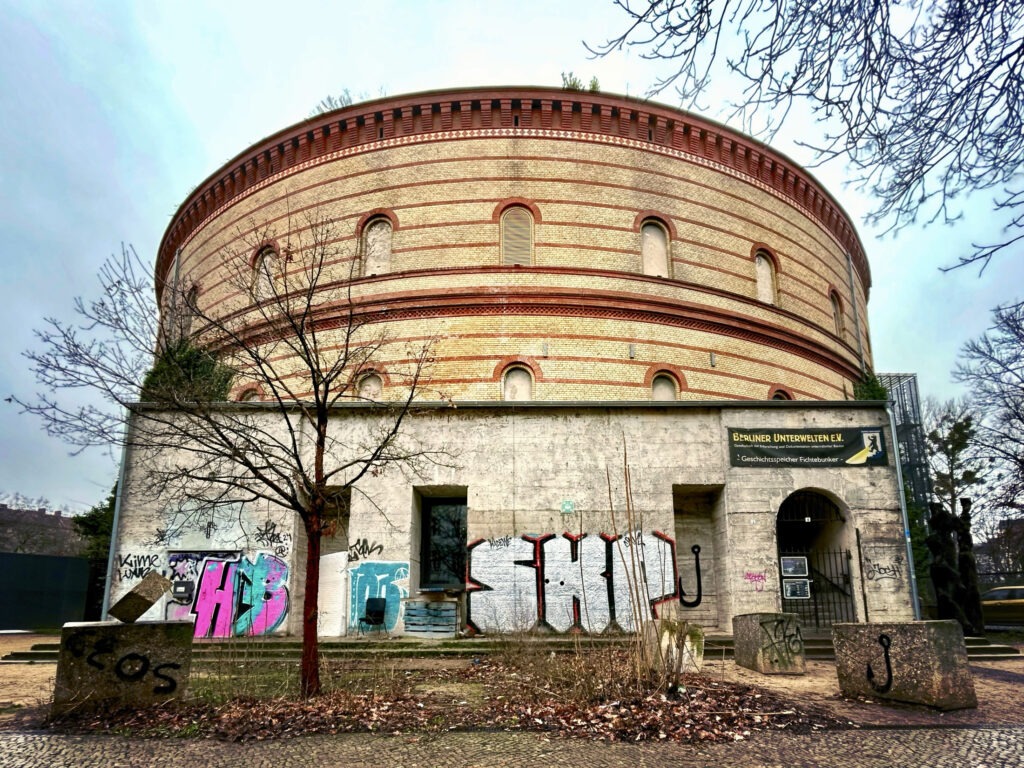
The Fichte Bunker has a long history from the Industrial Revolution to the Cold War. Today, the round building is a landmark in Kreuzberg
Quick Info
The Fichte bunker was one of four gasometers on Fichtestraße that provided gas for the city’s street lamps. In the 19th century, Berlin’s industry and population grew, and city life was meant to be modern and lively after work.
The first gasometers were built as early as 1826, but increasing demand from the growing city required more gasometers.
The Fichtestraße Gasometer Station was built in 1883 and remained in operation until 1936. The four gasometers had a total capacity of cubic meters of gas for street lighting in the district.
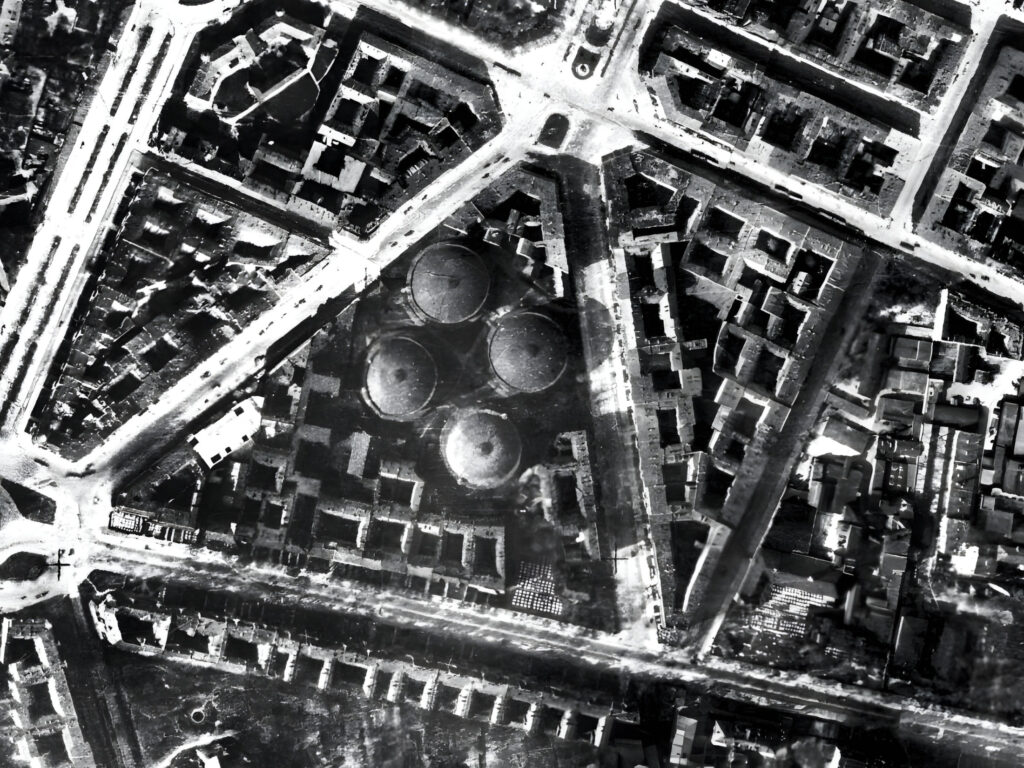
The gasometer closest to the street is the Fichte bunker today.
Repurposed as a Bunker
However, the growing electrification of society made Berlin’s gasometers obsolete, leading to the closure of the gasometer station on Fichtestraße in 1936.
This was just four years before the first air raids on Berlin, which Hitler and his regime did not expect.
In the fall of 1940, Hitler started the Führer sofort Program, or The Leader’s Immediate Program, which ordered the construction of bunkers. The gasometer on Fichtestraße nearest the street had its walls rebuilt with reinforced concrete and was turned into a bunker.
Photo by Chrissie Sternschnuppe@Flickr. CC BY-SA.
From 1942 until the end of World War II, the gasometer served as a luxury air raid shelter. Mothers working in weapons factories could come at 6 p.m. with their children and get a key to a room with bunk beds to stay safe overnight.
Refugee Center and Homeless Shelter
After the war, the bunker served as a refugee center for the many Germans who were expelled from former German territory and occupied areas. Every day, thousands of refugees were housed in the bunker for a single day before being sent on to the rest of Germany.
After the war in 1950s Berlin, life began to return to normal and the bunker was turned into a homeless shelter. But the neighborhood grew tired of the homeless after a woman was killed in nearby Hasenheide Park by one of them.
After that, canned food and toilet paper moved into the bunker.
West Berlin had experienced Stalin’s whims in 1948 and 1949, when supplies to the western part of the city were blocked. And since then, the Cold War had become even more serious.
The Senate in West Berlin had set up reserves of food and other necessities in various locations around the city in case a new blockade should arise. The Fichte bunker was one of these so-called Senate reserves until the end of the Cold War in 1991.
Gentrification of Fichte Bunker
After that, it took a long time before the Fichtebunker was brought back to life. In 2007, an architecture firm bought the bunker and built penthouse apartments and a green garden on the roof.
Berliner Unterwelten took over the two lower floors and restored the bunker. Now you can visit the Fichte bunker and learn about its history.
Read more about Berliner Unterwelten
Location:
Fichtestraße 6
10967 Berlin
Family friendly: Yes, but not on tours inside
Price: Admission applies
Experiences nearby
Related articles
Hitler’s Bunker in Berlin
The Humboldthain Flak Tower in Berlin